Now that it is hay baling season, I
shall now describe my 2nd fondest childhood activity. When I was a kid, the first
thing I looked forward to most of all was Christmas when I got all those swell
presents that I didn't deserve since I wasn't always good. My mother always declared
that we were never good, but what did she know. What did Santa Claus know?
What did everyone else know? The thing that was 2nd to this was
baling hay, which I will deal with in this chronicle. Baling hay was the
highlight of my summers. When I was a whole lot younger, I always exclaimed, "I'd rather make hay than make
love". Now that I'm "flirting" with 60, I can't do either
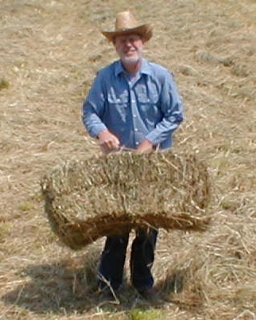
one too well. Thankfully, these days the hired young teenagers do most of the
heavy work for us and either Tim or I drive the tractor. Now and then, Tim will
help to load the wagon with the hired help. I sometimes also load the wagon
with hay bales, but only if I have about a week with nothing else to do since
I'll be laid up with my back sending me nasty messages. Both of us are starting
to feel our ages and our backs aren't as strong as they used to be. For that
matter, neither are our minds, but that's another story.
When we were kids, all the area farmers
would help each other bale hay. Every year 2 neighboring farmers, Glenn Shoop
and "Shorty" Schaffer would help. "Shorty" was missing the
top half of a finger and claimed it was the result of getting it caught in the
belt of his baler. Occasionally, we
would get help from 2 non farming family friends, Art Moon and Bob Schultz.
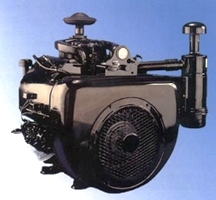
We had an old New Holland baler with a 4
cylinder Wisconsin air-cooled engine. It required a crank to start. The crank
went on the shaft and contained 2 angled slots to seat with the 2 stems on the
engine shaft. To start the engine, you
rapidly turned the crank once. As soon as it made one revolution, you had to
quickly pull it out or it could come around and hit your hand if the engine
should start. Many farmers had broken hands and/or wrists starting these
engines. When I was older, I got to turn the crank to start the engine. It
always frightened me a little bit when I heard the stories of broken hands and
wrists. However, in those days, I was much more fearless and never thought it
would happen to me. Fortunately it never did. Our baler was stored in John Reichly's
old barn just up the road. Every year when baling season started, they would
bring it to our place and that was always an exciting time for me. I would jump
up and down in my usual manic manner and yell, "Yippee! We're going to bale!"
As usual, every year at the start of baling season the engine wouldn't start
due to stuck valves. They would have to pull the valve covers off, and then
lightly hit the top of the valves with a hammer and screwdriver, and crank it
slowly until they became unstuck. The first time it started was also very
exciting for me. A bunch of dust and hay chaff would suddenly blow off the top
of the engine because the muffler was on top. It was flat and very thin.
Eventually it rusted away until there was just the straight pipe. It really sounded cool then with the loud deep
bass sound. When it was suddenly throttled down due to the design of the throttle
lever on a spring, it would backfire and emitted a long narrow light yellow
flame. This could be very dangerous especially when baling straw. Oddly enough,
it never occurred to anyone to buy a new muffler.
The old baler had a fold down bench on
the side, which was there to watch the knotter. When I was very young, I would
sometimes ride on it. The reason knotters had to be watched is that they are
very complicated and mysterious mechanisms and more often than "Knot"
(heh heh), they would malfunction. On the newer baler on the farm, the knotter
looks just the same as it did 50 years ago. I guess you can improve on perfection.
More often than "knot" (all right, I'll knock of the puns (for now)),
Tim and I would ride on top of the load. In fact, we still do this and the
exciting feeling is just the same as it was then as young kids. One time, while
on top of the load, part of it fell off the wagon just as we were crossing the
road, and we all hastily removed it from the road since it was blocking
traffic. Another time when I was on top a large portion of the load fell off
the wagon going up the barn ramp. I rode on top of the bales to the bottom and
thought it was great and a whole lot of fun! Whenever part of a load was lost
off the wagon, the stacker was not looked upon very highly since we had to restack
it on the wagon. In my younger hay baling days, I was known to loose a few
loads myself. Very embarrassing, indeed. Everyone would chide me with, "What kind of farmer's kid are
you!" At least I sheepishly helped them reload the wagon. I blamed it
on the ruts in the field and the tractor driver turning too fast and too
sharply on the rutty headlands. That sounds like as good a reason than anything
else I can think of at the moment or back then.
Another thing about the old baler was
the rhythmic sound the plunger made when we were stopped and no hay was going through
it. It sounded like: Crash Tick Tick Tick
Crash Tick Tick Tick Crash... I guess the best way to describe the sound is
for me to imitate it myself. CLICK HERE to hear what
it sounded like. Well at least a reasonable facsimile thereof. It had a mesmerizing
effect on me as a kid. The "crash" sound was about 1.5 seconds in
frequency. Since the plunger was only hitting the end of a bale when no hay was
coming in, I could never figure out what caused the loud "crash" sound
that was absent when it was baling the hay coming through it. When the baler
was running when we were stopped and if the tractor was in neutral, the
tractor, baler, and wagon would rock back and forth. This was caused by the heavy
baler plunger and arm moving back and forth. That was cool too. The present
modern baler on the farm causes a little rocking, but nothing like the old
baler did and there is no "crash" or ticking sound like our old baler.
In addition, the modern baler works off the tractor power take off. It's not
exciting starting it now since there's no engine or crank to pose a danger of
breaking a hand or wrist. I suppose if I did want a broken wrist I could dive
of the wagon... Nah, it wouldn't be the same.
In those days, we used baler twine with
a brand name of "Javelin". It had a drawing of a wild boar on the
package. I have always liked the smell of baler twine. Baler twine is made from
Jute. Interestingly enough, the Jute plant is in the same family as the Cannabis
plant, which, of course, is marijuana.
Now I'm sure that none of you, my readers, know about Cannabis plants.
If any of you do know, SHAME ON YOU!!!! Although the Jute "twine
plant" is related to the Cannabis plant, there's no THC in it so don't bother
to dust off your old "Bongs" and go out and buy a big bale of baler
twine.
For years, we have known that in order
to get into the barn door, the wagon loads of hay cannot be over 7 bales high.
One time Bob Shultz was showing off and stacked the wagon 9 high in a pyramid
style. We didn't notice how high it was and when the tractor pulled the load
in, the top 2 tiers hit the eave trough on the barn roof and 2 rows of the top
2 tiers were pushed of the back. The dent in the eave was there for years until
they were replaced a few years ago.
Since it was too difficult to back the
empty hay wagon down the barn ramp hitched to the tractor, we unhooked it, one
guy steered with the wagon tongue, and the others beside him held the wagon
back to keep it going slowly down the ramp. We had to really hold back and drag
our feet or the wagon would get out of control with too much speed. One time we
couldn't stop it from rolling too fast so we just let go of it. The guy
steering the tongue of the rapidly rolling wagon turned too far to the right
and the hayrack hit our gas barrel. The dent in it was there until we replaced
the gas barrel a few years ago. The large dent had red paint from the hayrack
for several years too. Our poor gas barrel got another licking when one time I
was filling the tractor and baler gas tanks, pulled away, and turned too
sharply and the bale chute caught the leg of the gas barrel and turned it over.
You can read about this on the link below with 2 of my previous "oldies
but goodies" stories. The story is titled: "Over A Barrel". Another baler story is also linked below
titled: "Baler Self Destruct".
I would suggest you finish this story first to maintain the continuity. On the
other hand, since when did any of my stories ever have any continuity in the
first place?
Another thing I always liked about
baling hay is the pleasant aroma of fresh cut hay. After about one day after
cutting and as it's drying out, that wonderful aroma is the sweetest one this
side of heaven! At least to me it is.
The other day Tim said that it's time to
start cutting hay since its early June. UGGGGH!!!! I sure don't look forward now
to hay season. I had better quickly stock up on Tylenol for my forthcoming
aching back. It is just not the same now as when I was a kid. I'm not growing
old gracefully!